Research intelligence that keeps you connected to the evidence.
Explore a question across the literature, bring the evidence together, and understand what it supports — without losing sight of the research underneath.
Forefront connects discovery, evidence synthesis, scientific relationships and confidence into one research environment.

Finding the papers is only the beginning.
A literature search can tell you what has been published. Understanding a scientific question means working out which evidence matters, how studies relate, where findings agree, where they conflict and what remains uncertain. Forefront helps you move through that process without breaking the connection to the underlying research.
Find the relevant evidence
See relationships across the research
Bring findings together
Understand strength and uncertainty
See how the evidence changes
AI that takes you back to the source.
Forefront synthesises across research while preserving the connection between generated insights and the evidence behind them. Follow a claim back to its supporting source, inspect the research yourself, and continue exploring from there.
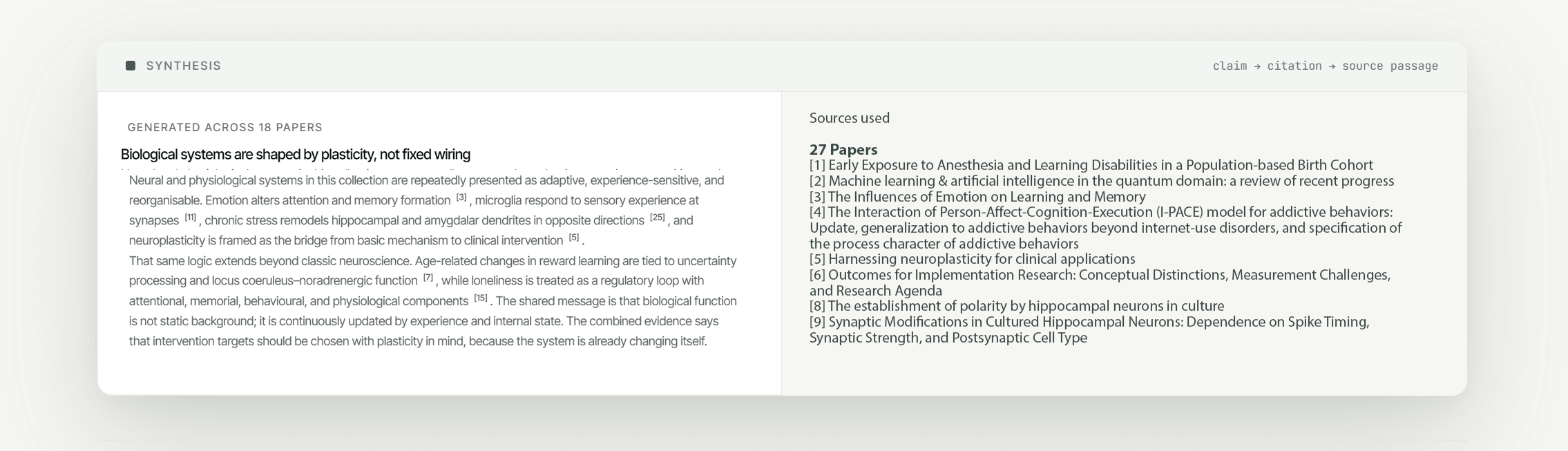
Synthesis is generated across the research you're investigating, not presented as an isolated answer.
Supporting evidence stays attached to the claims it informs.
Move from an interpretation back to the underlying source whenever you need to go deeper.
Use synthesis to identify patterns, comparisons and questions worth investigating further.
Don’t just summarise the literature. Interrogate it.
Bring research together around a question and examine what the evidence is actually saying. Compare findings, methods and outcomes; surface disagreement; and identify where the literature is strong, fragmented or incomplete.
GLP-1 receptor agonists reduce body weight in adults with obesity.
Randomised trial reporting the same direction of effect
Outcomes trial testing a related endpoint in the same population
Same intervention studied in adolescents rather than adults
Real-world evidence from routine clinical practice
Subgroup analysis finding no significant benefit
Durability after treatment is discontinued
How much confidence should the evidence give you?
Not every scientific conclusion deserves the same level of confidence. Forefront’s Confidence Engine brings together the available evidence to help show how strongly a conclusion is supported — including the uncertainty around that assessment.
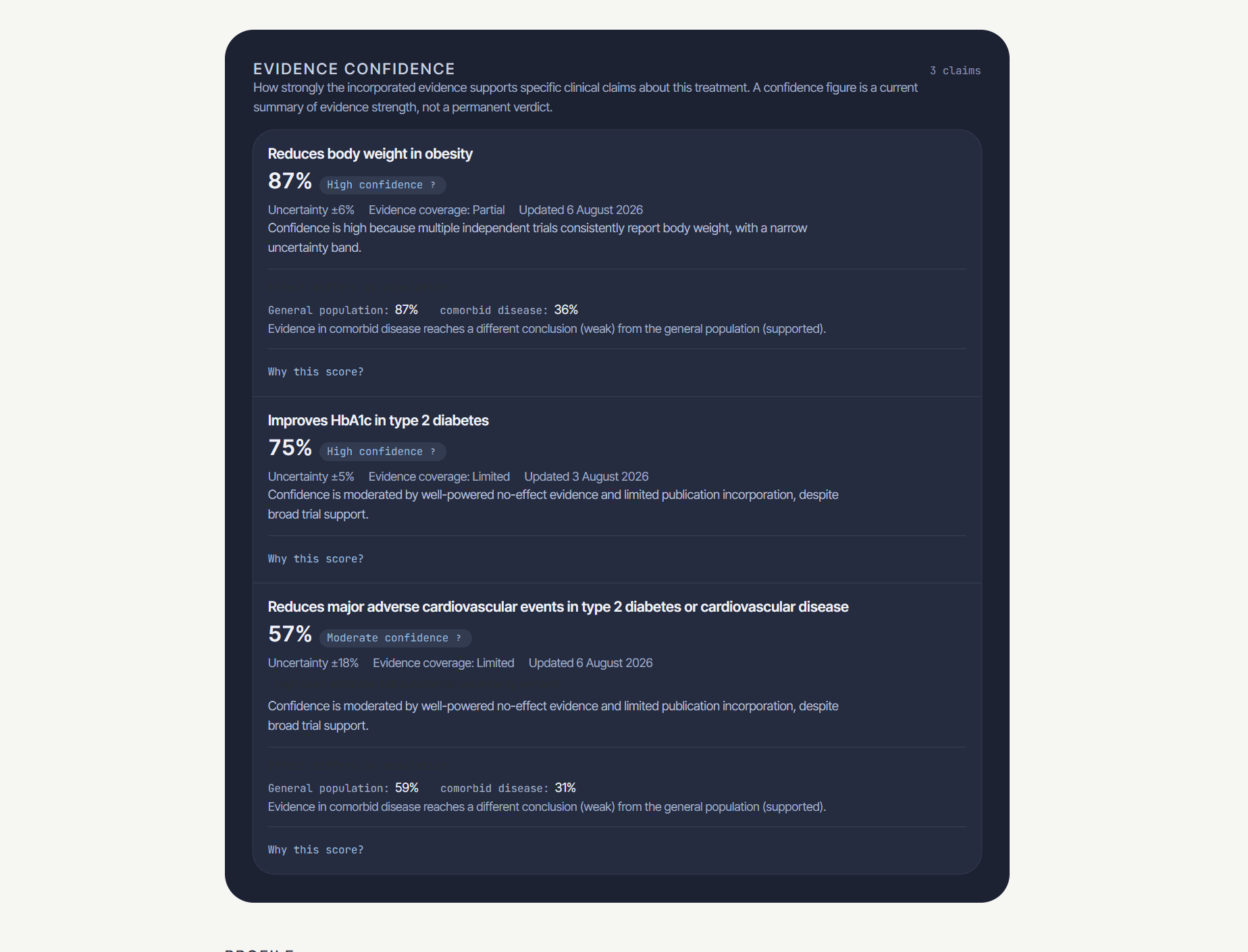
See an assessment together with its uncertainty rather than reducing complex evidence to a definitive answer.
Understand what kinds of evidence contribute to an assessment.
See where findings reinforce one another and where important disagreement remains.
Follow the assessment back to the evidence that produced it.
Every answer sits inside a wider scientific context.
Research findings don't exist independently of the diseases, therapies, biological targets, researchers and trials around them. Forefront connects those entities so that investigating one piece of evidence can lead naturally into the wider scientific picture.
Research that doesn’t stop when you close the tab.
A research question isn't necessarily finished when you've written a summary. Save the work into Forefront, organise it around a Project or research theme, and return as new evidence appears.
Keep the research behind an investigation together.
Monitor the topics and Landscapes surrounding it.
Surface relevant new research and activity when you return.
Continue an investigation rather than starting another search from scratch.
AI should help you investigate, not ask you to trust it.
Forefront is being designed around a simple principle: intelligence should remain connected to evidence. That means preserving citations, exposing uncertainty, making underlying sources inspectable and treating conflicting evidence as something to investigate rather than something to smooth away.
Primary evidence remains accessible.
Follow interpretations back to their sources.
Confidence isn’t presented as certainty.
Answers should create better questions.
Don’t stop at finding the research.
Understand how the evidence connects, what it supports and where the questions remain.